
About the Client
A financial institution undertaking the migration of a resource-intensive SaaS application from its on-premises data center to Microsoft Azure, with a focus on scalability, performance, and cost optimization.
Business Requirements
The client needed to modernize its infrastructure while ensuring a cost-efficient migration strategy and long-term scalability for future growth.
• Establish a cost-neutral migration model from on-premises infrastructure to Azure.
• Build a reliable forecasting model to support future infrastructure growth and capacity planning.
• Map compute, storage, and infrastructure components to cloud services while maintaining or improving performance.
• Optimize operational costs without compromising application reliability or customer experience.
• Create a scalable cloud foundation capable of supporting multiyear business growth.
Our Solution
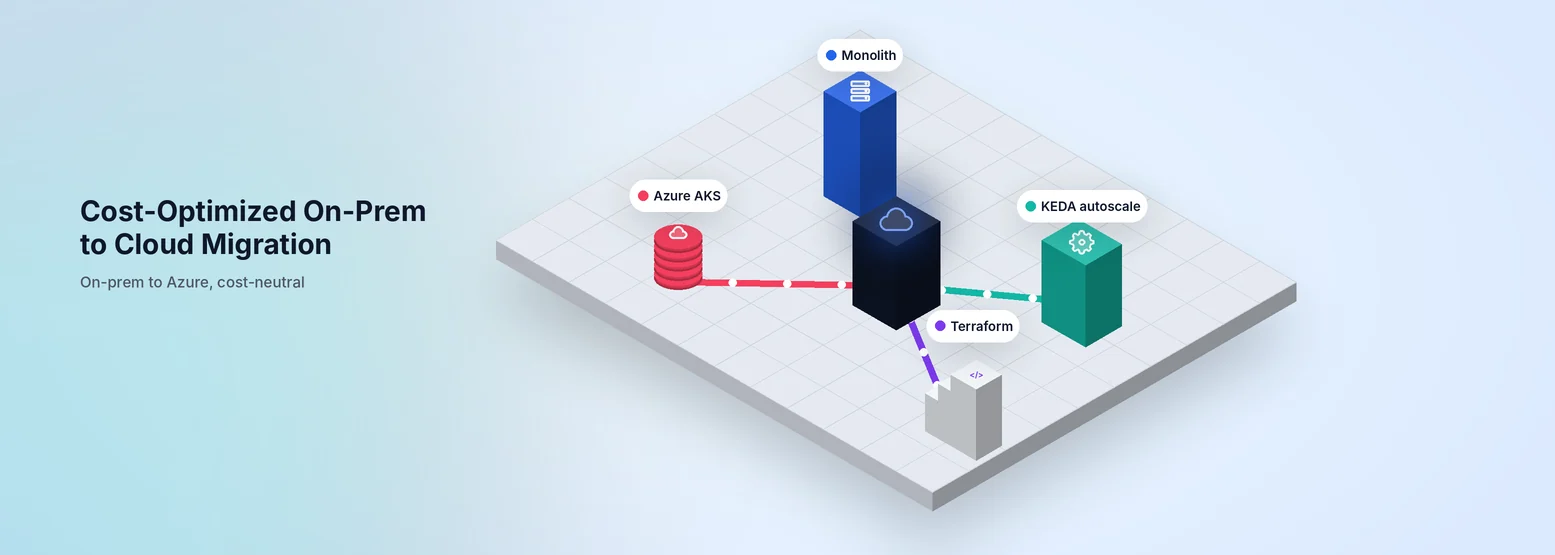
• Re-platformed the legacy monolithic application to a cloud-native architecture hosted on Microsoft Azure.
• Implemented intelligent autoscaling mechanisms based on system load, performance metrics, and operational parameters.
• Performed detailed capacity planning and workload analysis to maximize utilization of cloud resources and infrastructure investments.
• Refactored the application architecture to support large-scale data growth and evolving business requirements.
• Introduced Kubernetes-based orchestration and containerization for improved scalability and workload management.
• Leveraged Infrastructure-as-Code (IaC) practices using Terraform to automate provisioning, deployment, and environment management.
Impact & Benefits
• Developed a migration blueprint that was subsequently adopted by other business units for their cloud transformation initiatives.
• Improved cost governance and infrastructure utilization through continuous monitoring and optimization practices.
• Achieved significant cost efficiencies through autoscaling and right-sizing strategies while maintaining customer satisfaction and performance standards.
• Enabled on-demand provisioning of non-production environments, resulting in additional cost savings and operational flexibility.
• Established a scalable and future-ready cloud platform capable of supporting sustained business growth and increasing data volumes.
Tech Stack
• Java
• C++
• Microsoft Azure
• Kubernetes
• Docker
• Terraform
• KEDA
Team Structure
• Cloud Architects
• Platform Engineers
• DevOps Engineers
• Application Modernization Specialists
• Infrastructure Automation Engineers
Have a challenge in mind?
Let’s talk