
About the Client
A Real Estate Asset Investment company undertaking a strategic application modernization initiative to transform legacy systems and establish a unified data platform.
Business Requirements
The client sought to modernize a legacy monolithic application while building a centralized data platform capable of supporting real estate investment operations at scale.
• Create a canonical data model for Real Asset investments across multiple fund classes.
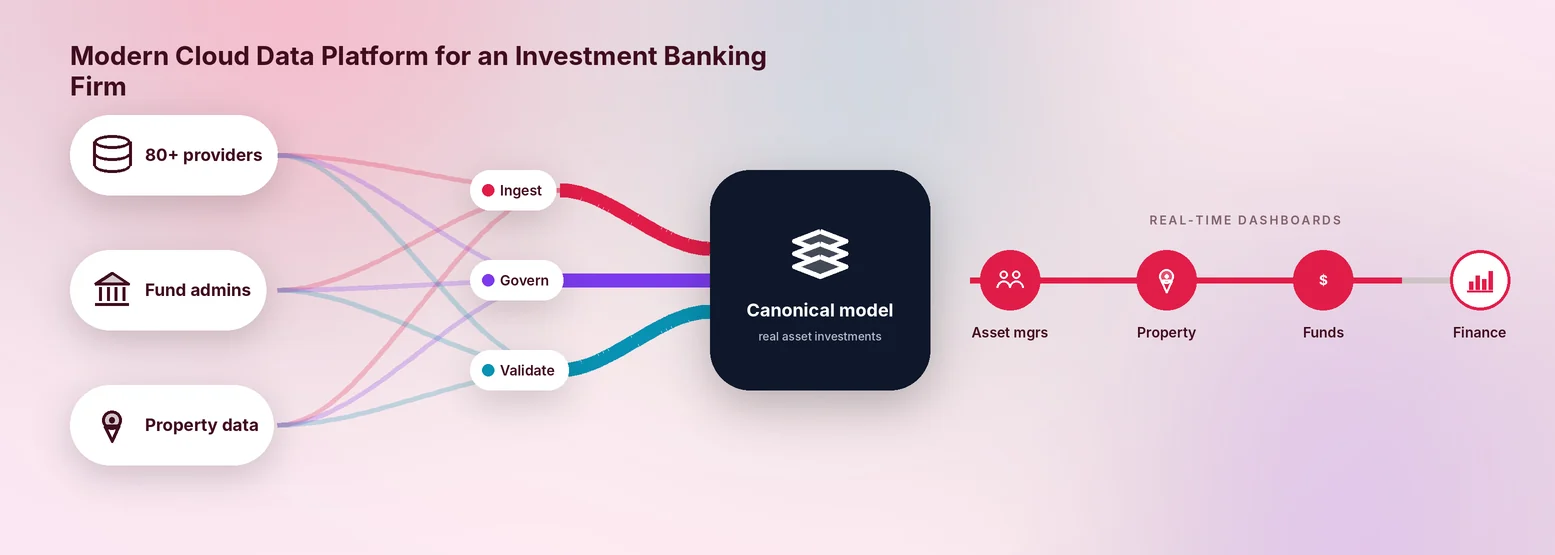
• Integrate data from more than 80 source systems into a unified platform.
• Strengthen data governance, quality controls, and compliance across the organization.
• Deliver business dashboards and reporting capabilities for Asset Managers, Property Managers, Fund Administrators, and Finance teams.
• Enable scalable, cloud-native operations with improved reliability and performance.
Our Solution
• Re-platformed the legacy application to a modern cloud-native architecture, improving scalability, maintainability, and operational efficiency.
• Designed and implemented a canonical data model to unify Real Asset investment data across multiple fund classes and business domains.
• Developed data ingestion pipelines to integrate data from 80+ providers while enforcing governance, validation, and data quality controls.
• Built business dashboards and data products that provide real-time insights for investment, operations, and finance stakeholders.
• Deployed the complete solution on Kubernetes with Horizontal Pod Autoscaling (HPA) to support dynamic workloads and business growth.
• Implemented multi-region redundancy and failover capabilities to ensure high availability and business continuity.
• Automated reporting and consumption transparency to provide visibility into usage patterns, operational performance, and cost management.
Impact & Benefits
• Delivered a modernized cloud-native application platform aligned with all business and operational requirements.
• Achieved high availability through automated failover mechanisms and full data replication strategies.
• Strengthened governance, compliance, and risk management through centralized data controls and quality frameworks.
• Enabled real-time business insights through dashboards, analytics, and automated transparency reporting.
• Established a scalable, future-ready architecture that improves system performance while reducing long-term operational costs.
Have a challenge in mind?
Let’s talk